
door vs underbed storage is not a contest with one universal winner. The better location depends on what you store, how often you retrieve it, the available clearance, and whether the added container changes how a door or escape route works.
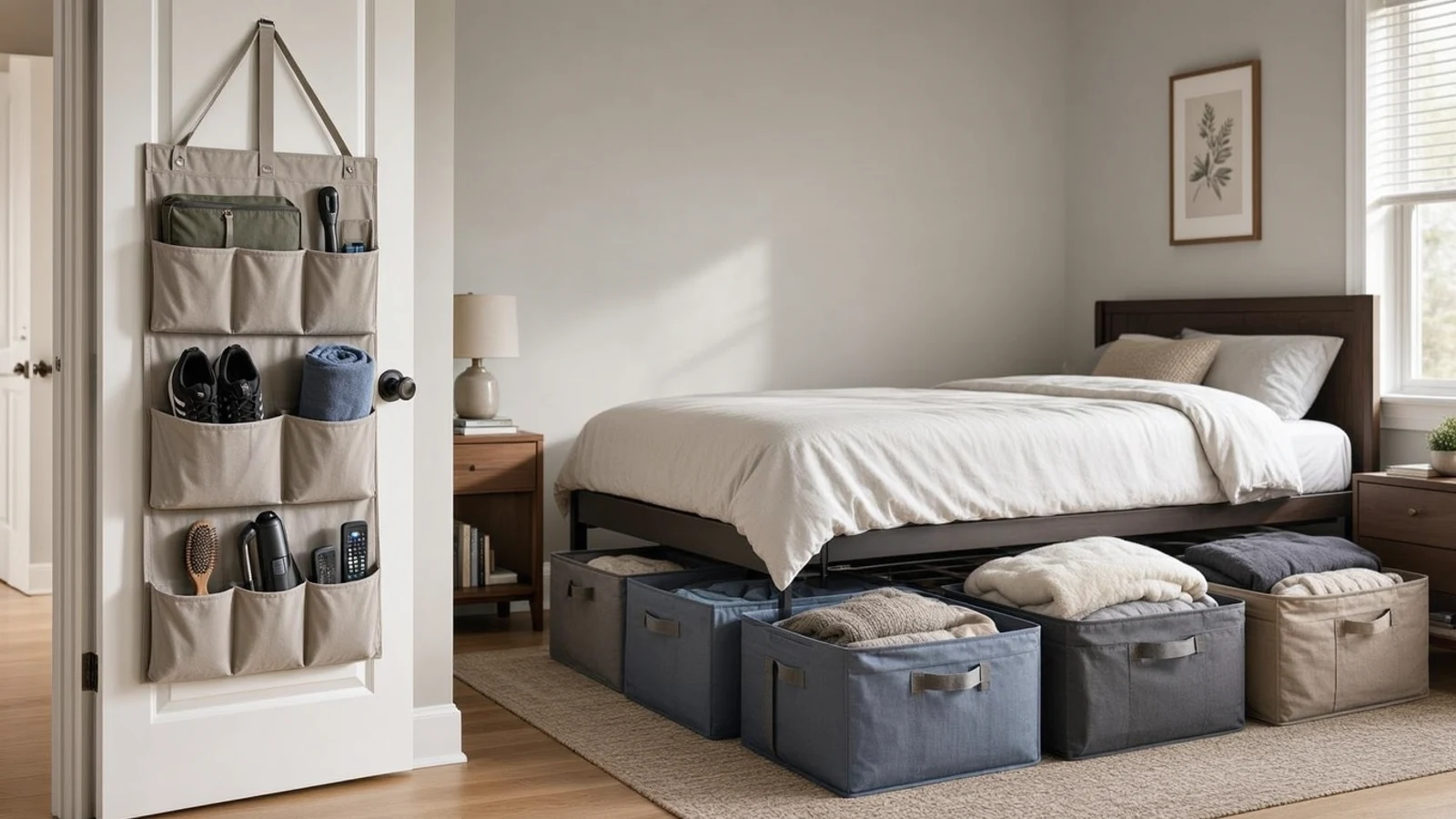
The illustrations in this guide are AI-generated editorial illustrations, not official product photography. Product cards use retrieved Amazon imagery. Prices, ratings, and review counts below are dated marketplace snapshots, not proof of product quality or a substitute for checking current specifications.
Table of Contents
- The basic choice
- Access frequency and item type
- Clearance, dust, and movement
- Safety and accessibility checks
- Product options
- Decision framework
- Limitations
- Frequently Asked Questions
- Conclusion
The Basic Choice
What the door zone does well
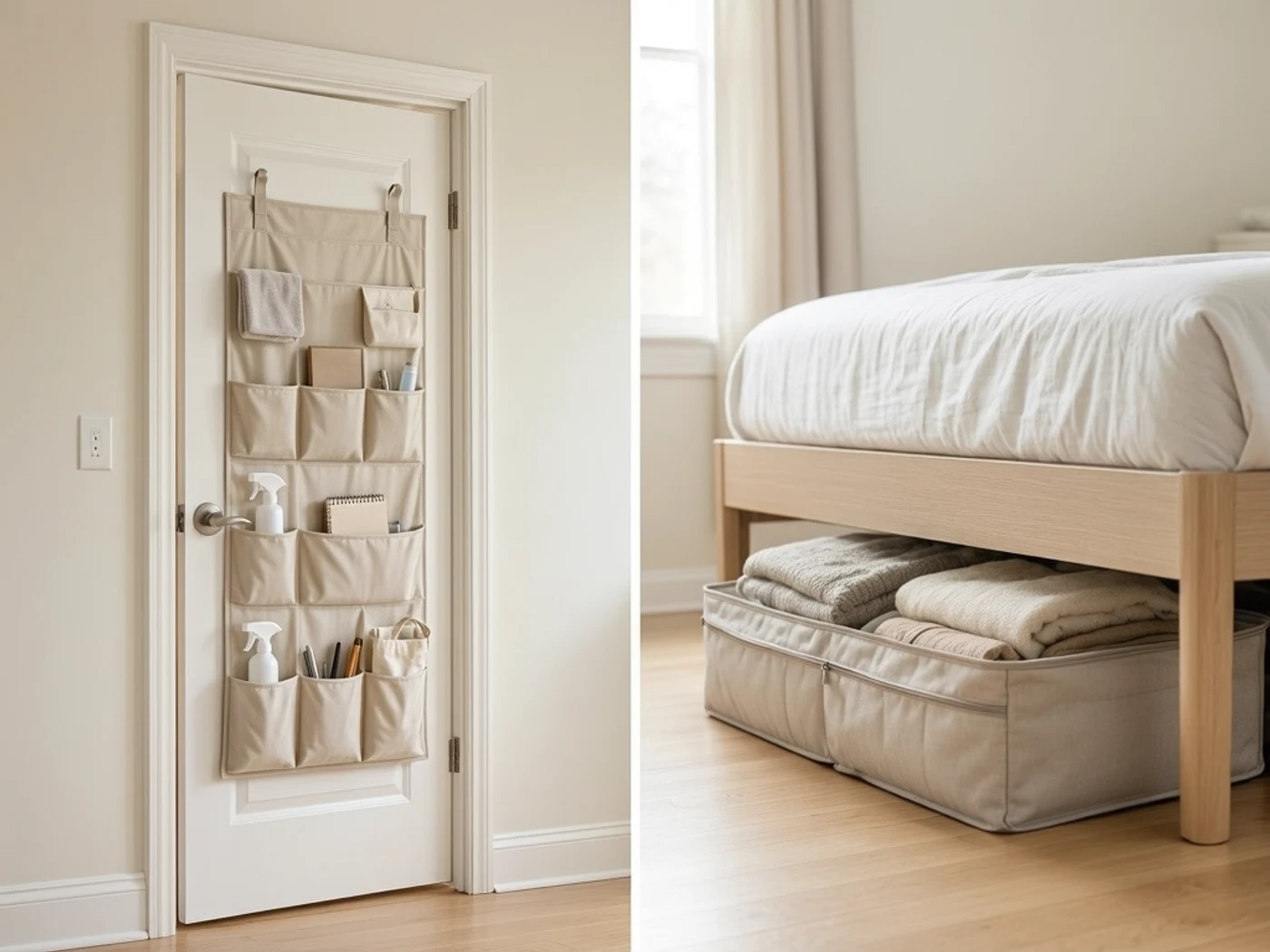
An over-door organizer turns unused vertical space into a series of small compartments. It is most useful when the stored items are lightweight, easy to identify, and needed often enough that bending, kneeling, or pulling out a container would become annoying.
The door location also keeps contents visible at standing height. That visibility can support a simple routine for accessories, small shoes, cleaning supplies, or packaged items, although the exact fit depends on pocket dimensions and the door’s available clearance.
The tradeoff is movement. A loaded organizer adds depth and weight to a moving panel, so the door may feel different to open and close. It can also conflict with trim, a nearby wall, a latch, a doorknob, or another door.
What the under-bed zone does well
Under-bed storage uses horizontal space that is often difficult to use for anything else. It is better suited to folded garments, spare blankets, linens, and seasonal goods that can remain packed for weeks or months.
The low position keeps the storage visually quiet and leaves wall and door areas available for other uses. A zipper bag with a clear window can make a large soft container easier to identify, but it still requires enough bed clearance and floor space to pull the bag out.
Under-bed storage is less convenient for daily retrieval. Dust, bed frames, rugs, and limited reach can make access slower, especially when several bags are stacked or when the bed must be moved.
Access Frequency and Item Type
Match the zone to the retrieval pattern
Use the door for small items with a high retrieval frequency. A household might place frequently used shoes, hair accessories, gloves, or compact cleaning items there. Keep heavier or sharp objects out unless the organizer and door are specifically designed to handle them.
Use the under-bed area for low-frequency storage. Guest bedding, out-of-season clothing, spare curtains, and other soft goods are logical candidates because they do not need to be reached several times each day.
A practical test is to describe the retrieval action. If you want the item while standing and leaving the room, the door may be the better zone. If you can retrieve it during a seasonal change or linen rotation, the under-bed area may be more efficient.
Protect sensitive materials
Neither zone is automatically suitable for every material. Textiles need protection from excess moisture, pests, dust, crushing, and unsuitable folds. The Smithsonian Institution’s guidance on storing antique textiles is especially relevant when the contents are historic, fragile, valuable, or irreplaceable.
Avoid treating a basic organizer or fabric bag as archival storage. Delicate textiles may need different folding, wrapping, ventilation, and environmental controls than ordinary household clothing. Do not compress fragile items simply to make a container fit.
For hanging garments, the National Park Service storage guidance provides a useful reminder that support and shape matter. A door pocket is not a replacement for an appropriate hanger, and an under-bed bag is not a reason to fold a garment that should remain supported.
Clearance, Dust, and Movement
Compare the physical clearances
Before choosing the door, measure the space between the closed door and the frame, adjacent wall, furniture, and trim. Also consider the organizer’s loaded depth rather than its empty depth. A compartment that looks slim in a listing can become less practical when filled.
For under-bed bags, measure the usable height from the floor to the lowest obstruction. The supplied Amazon Basics bags are listed as 18 x 42 x 6 inches, but those published dimensions do not establish the clearance under a particular bed. Check the frame, wheels, center supports, and any lip that could catch a handle or zipper.
The door must still open, close, latch, and move without scraping. The bed must still be stable, and the bag must pull out without forcing the frame or damaging the floor. These are fit questions, not conclusions that can be made from a product name alone.
Consider dust and visibility
An open or mesh-style door organizer may expose contents to room dust. Its visibility is useful for identification, but visible contents can also make the room look busier. Covered pockets, labels, and a restrained loading plan may help, subject to the product’s construction.
A zipped under-bed bag generally creates a more enclosed barrier than an open pocket organizer, but it is not automatically dustproof, pest-proof, moisture-proof, or airtight. Store only clean, fully dry textiles, and inspect bags periodically rather than assuming concealed means protected.
For more ideas about small-space products, consider the whole room rather than filling every unused surface. A storage zone is successful when it reduces friction without creating a new obstacle.
Safety and Accessibility Checks
Keep exits usable
Storage should never reduce a safe route out of a room or home. Ready.gov’s home fire escape planning guidance supports keeping escape paths planned and usable, including knowing how doors operate during an emergency.
Do not place a door organizer where it prevents the door from opening as intended, blocks a required exit, catches on a handle, or creates a loose item that could fall into the route. Do not leave an under-bed bag partly extended across a walking path.
The U.S. Access Board’s accessible-routes guidance is a useful reference for thinking about clear width, protrusions, and maneuvering space. Household needs vary, so people using mobility aids, children, or anyone with limited balance may require more generous clearance than a quick visual check suggests.
Use a conservative loading approach
An organizer’s pockets are not an invitation to fill every compartment with dense objects. Distribute contents, keep the heaviest items low when possible, and follow the product’s instructions. If the door sags, swings unexpectedly, rubs, or becomes difficult to latch, remove the organizer and reassess.
For bags under a bed, avoid overfilling until the zipper strains or the bag becomes too tall for the space. Handles should not remain where they can catch feet, wheels, or a vacuum head. Labeling the outside can reduce repeated pulling and rummaging.
Product Options
Door option: Amazon Basics 24-Pocket Over-the-Door Shoe Organizer

Checked Jul 2026
Amazon Basics 24-Pocket Over-the-Door Shoe Organizer
A current winning product selected through the Home Utility research and qualification workflow.
- Best for
- Best suited to lightweight, frequently retrieved small items when door and frame clearance are adequate.
- Know before buying
- Check door movement, trim, hardware clearance, and loading guidance before installation.
This is the more accessible format for compact items that benefit from visible compartments. Its 24-pocket layout may help separate categories, but the listing data does not establish how every door, pocket, or item combination will perform in a particular room.
The displayed price is $7.34, with a 4.6 rating from 32,606 reviews as verified on 2026-07-12. Those figures are marketplace snapshots rather than quality proof. See our storage-solutions category for broader organization choices, and review current specifications before buying.
Under-bed option: Amazon Basics Under Bed Storage Bags

Checked Jul 2026
Amazon Basics Under Bed Storage Bags for Clothes and Blankets, Foldable Fabric Zipper Container with Clear Window and Reinforced Handles, Space Saving, 18 x 42 x 6 inches, Gray, 2-Pack
A current winning product selected through the Home Utility research and qualification workflow.
- Best for
- Best suited to folded clothing, blankets, and seasonal soft goods used less frequently.
- Know before buying
- Confirm bed clearance and floor access; the listed dimensions do not guarantee fit or protection in every room.
This two-pack format is oriented toward larger, soft items that can stay beneath a bed. The clear window and handles may support identification and retrieval, but usefulness will depend on how much clearance remains after loading.
The displayed price is $17.09, with a 4.3 rating from 15,547 reviews as verified on 2026-07-13. Again, these are dated marketplace signals, not independent performance results or quality certification. For a wider comparison, browse best small-space products and confirm dimensions against your furniture.
Side-by-Side Comparison
| Criteria | Door | Underbed |
|---|---|---|
| Typical access | Fast, standing access | Slower, requires pulling out |
| Best item profile | Small and lightweight items | Folded clothing, blankets, and linens |
| Visibility | Open compartment visibility | Window or label visibility |
| Main clearance concern | Door, frame, trim, and hardware | Bed height, supports, rugs, and floor space |
| Movement concern | Added weight affects door movement | Bag can catch or obstruct a walking path |
| Dust exposure | Depends on pocket construction | More enclosed but not automatically sealed |
| Strongest use case | Daily-use small items | Seasonal or occasional soft goods |
This table is a planning aid, not a guarantee of capacity, durability, safety, or fit. The right choice can change when a room’s furniture, occupants, door hardware, flooring, or evacuation needs change.
Decision Framework
Choose the door when access matters most
Select the door zone when the contents are lightweight, frequently used, and easy to divide into small categories. It can be a sensible answer for a narrow room with spare door clearance but little accessible floor area.
Before committing, open the door fully, inspect the frame and nearby wall, and imagine the organizer loaded. If the door becomes hard to operate or the route narrows, the convenience benefit is not worth the interference.
Choose under the bed when concealment matters most
Choose the under-bed zone when you have suitable clearance and mostly store soft goods that are not needed daily. It keeps storage visually discreet and makes use of otherwise inactive floor-level space.
Plan retrieval before filling it. Leave enough room to pull the bag out, label contents clearly, and keep the exposed bag from becoming a trip hazard. If you cannot safely reach or remove it, the nominal capacity is less useful.
Combine zones selectively
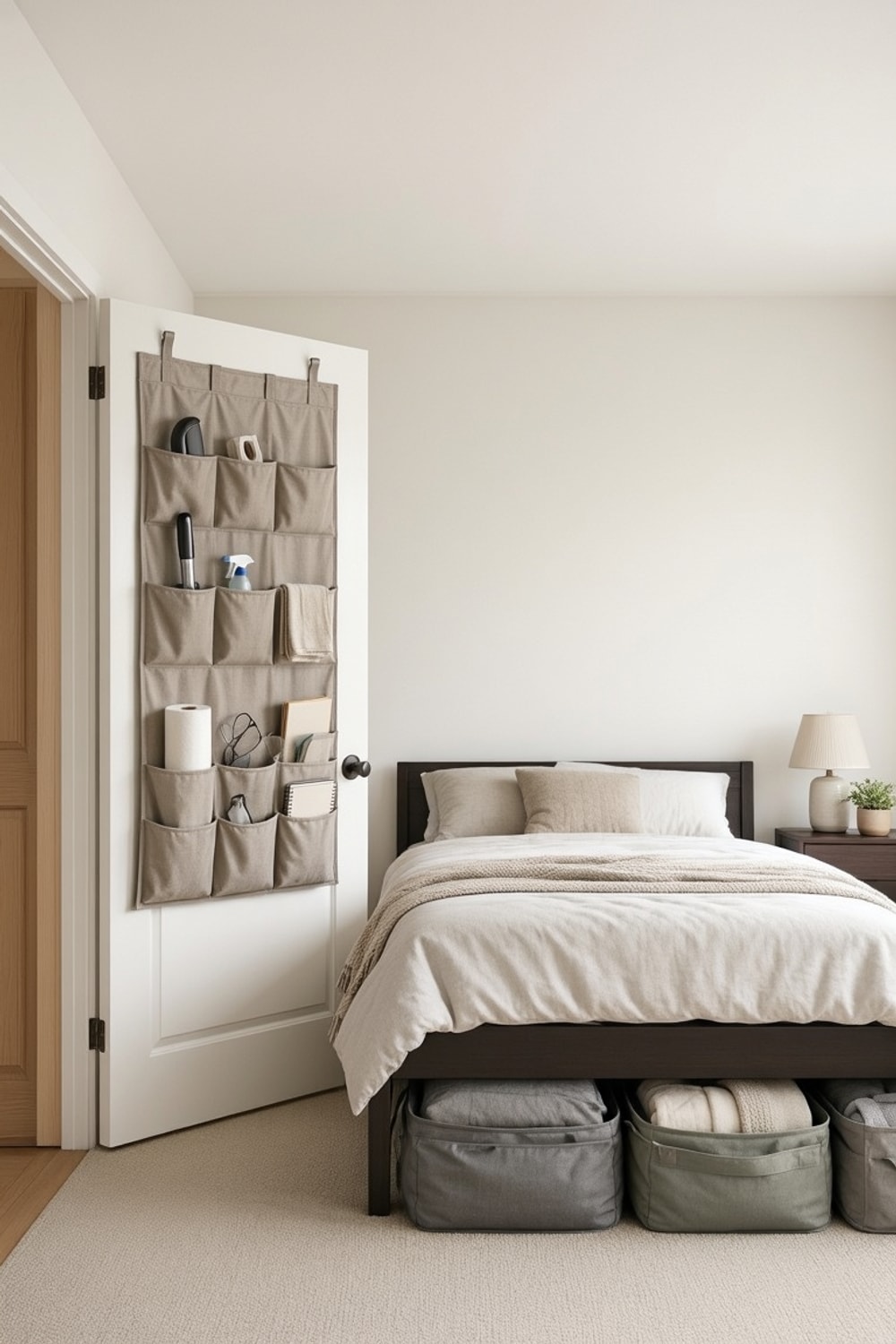
Some rooms benefit from both approaches. Keep daily-use small items near the door and reserve under-bed space for seasonal textiles, spare bedding, or backup supplies. This separates high-frequency access from long-term storage instead of making one zone handle every category.
Use the small-space product finder to explore alternatives, then check dimensions and route clearance yourself. Keep your room measurements current.
Limitations
This comparison relies on supplied product listings, dated marketplace snapshots, and general planning principles. It does not include independent laboratory testing, a physical inspection, verified load testing, measurements of your door or bed, or an assessment of a particular building’s fire and accessibility requirements.
Product ratings, review counts, prices, utility ranks, commission price ranks, and marketplace signal ranks were supplied as dated data. They should not be interpreted as proof of construction quality, safety, longevity, capacity, or fit. Product availability and specifications can change after the stated verification dates.
The source material provides context about textile care, hanging garments, escape planning, and accessible routes. It does not certify either supplied product for a particular use. For fragile collections, mobility-access needs, or regulated egress questions, consult an appropriately qualified professional and follow applicable local requirements.
This door vs underbed storage guide does not establish that either product is appropriate for every room or occupant. Measurements, loading decisions, and local safety requirements remain the reader’s responsibility.
Frequently Asked Questions
Which storage zone is better for items I use every day?
The door is usually more convenient for small, lightweight items that you retrieve often, provided the organizer does not interfere with door movement. Check the door’s operation after loading it.
Are under-bed storage bags better for seasonal items?
Usually. Their concealed position and larger footprint suit folded clothing, spare bedding, and other items used less frequently. Confirm that the bags fit and can be removed without creating an obstruction.
Can an over-door organizer damage a door?
It can create clearance, weight, or hardware problems if the door, frame, hinges, or organizer are incompatible. Check fit and loading guidance before use.
What should never block a door or escape route?
Storage should not restrict a required exit, prevent a door from opening as intended, or create a trip hazard in the route to safety. Keep the route usable for everyone in the household.
Conclusion
A door vs underbed storage choice should begin with retrieval frequency and complete clearance. Revisit the door vs underbed storage decision after loading the zone, because real door movement and bag removal can expose conflicts that empty measurements miss.
There is no universal winner between the two zones: use the door for lightweight, frequent-access items and the under-bed area for concealed, occasional soft goods, after checking clearance and safe movement. The most useful door vs underbed storage decision is the one that preserves access, protects the contents, and keeps the route through the room clear. Review your actual measurements before purchasing, and consult our editorial policy to understand how product and source information is handled.