
Measure cabinet organizers before ordering by recording the smallest usable width, depth, and height, then checking hinges, lips, pipes, cords, hand access, and removal space. A cabinet may look spacious while its face frame, door, plumbing, or shelf edge prevents an organizer from entering or operating normally.
This kitchen cabinet measurement guide applies to dividers, racks, turntables, bins, and pull-out storage. It does not assume that a listed product will fit every cabinet, because the cabinet, stored item, and organizer must be compared as one system.
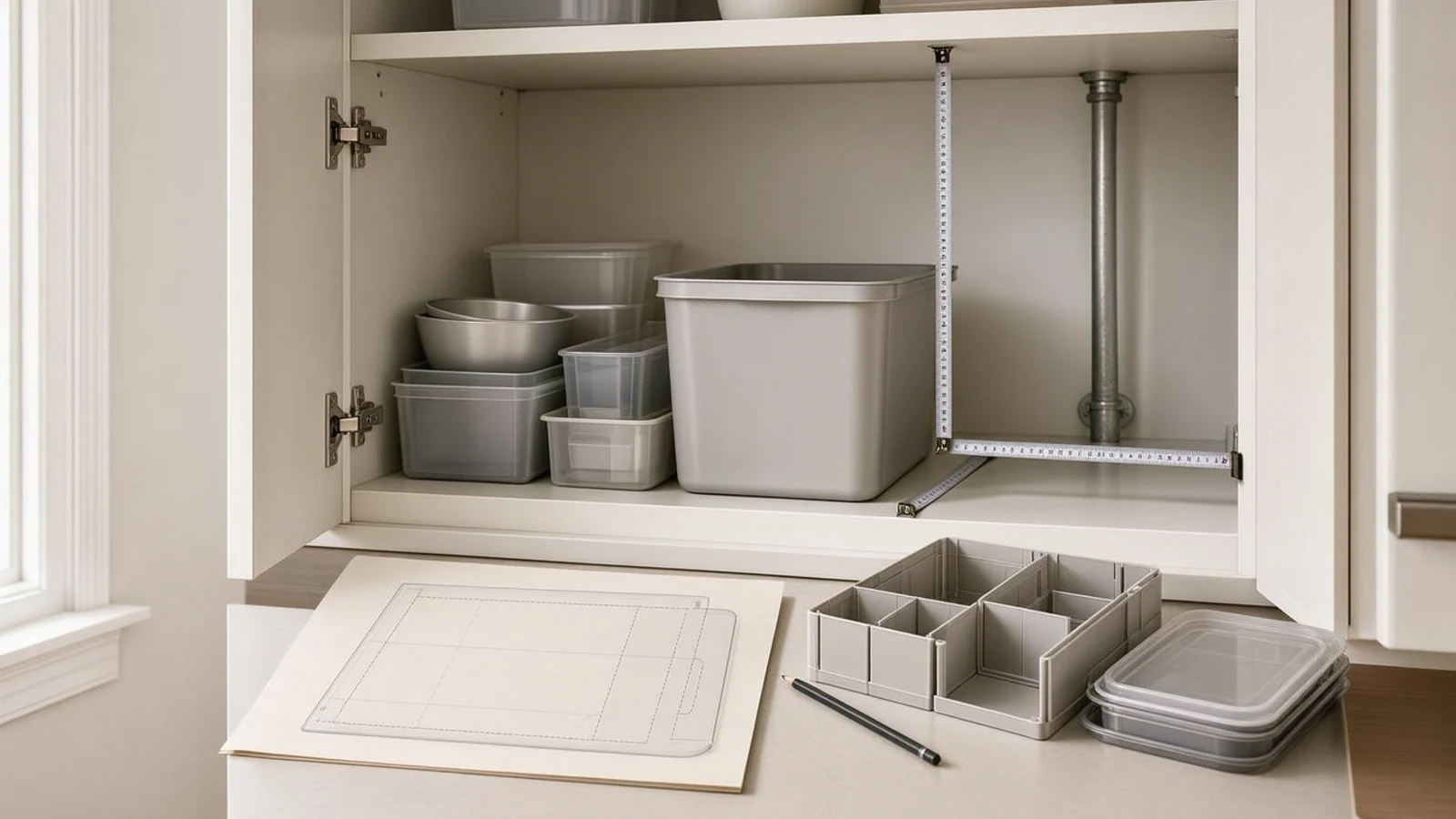
Table of Contents
- Start with the cabinet, not the product
- Follow the measurement sequence
- Check obstructions and operating clearance
- Compare organizer and item dimensions
- Review two example organizers
- Use the final fit checklist
- Limitations
- Frequently Asked Questions
- Conclusion
Start with the cabinet, not the product
Before opening a product page, decide where the organizer will sit and what motion it must make. A stationary divider needs room for its stored items, while a pull-out rack needs clearance for its complete travel. A turntable needs space around its widest rotating point, not merely a shelf wider than its diameter.
If you are comparing small-space projects, the best small-space products guide can help identify a solution type first. The small-space product finder offers another starting point, but you still need to verify actual cabinet and product dimensions.
Measure the usable area
Open the door fully and remove loose contents before measuring. Measure interior width at the front, middle, and back, and record the smallest number. Repeat near the bottom and top if the cabinet tapers or has a face frame, because that narrowest section controls the fit.
Measure depth from the rear obstruction to the point where the organizer can sit without preventing the door from closing. A hinge, pipe, outlet, or rear brace can shorten usable depth even when the cabinet box is deeper. Measure clear height from the actual supporting surface to the lowest obstruction above it, including a shelf underside, drawer hardware, ledge, or cabinet frame.
If the organizer must be lifted into place, measure the diagonal or entry opening as well. A product may fit the interior once installed but fail to pass through the door. Record each result in inches or centimeters and avoid rounding a tight measurement upward.
Follow the measurement sequence
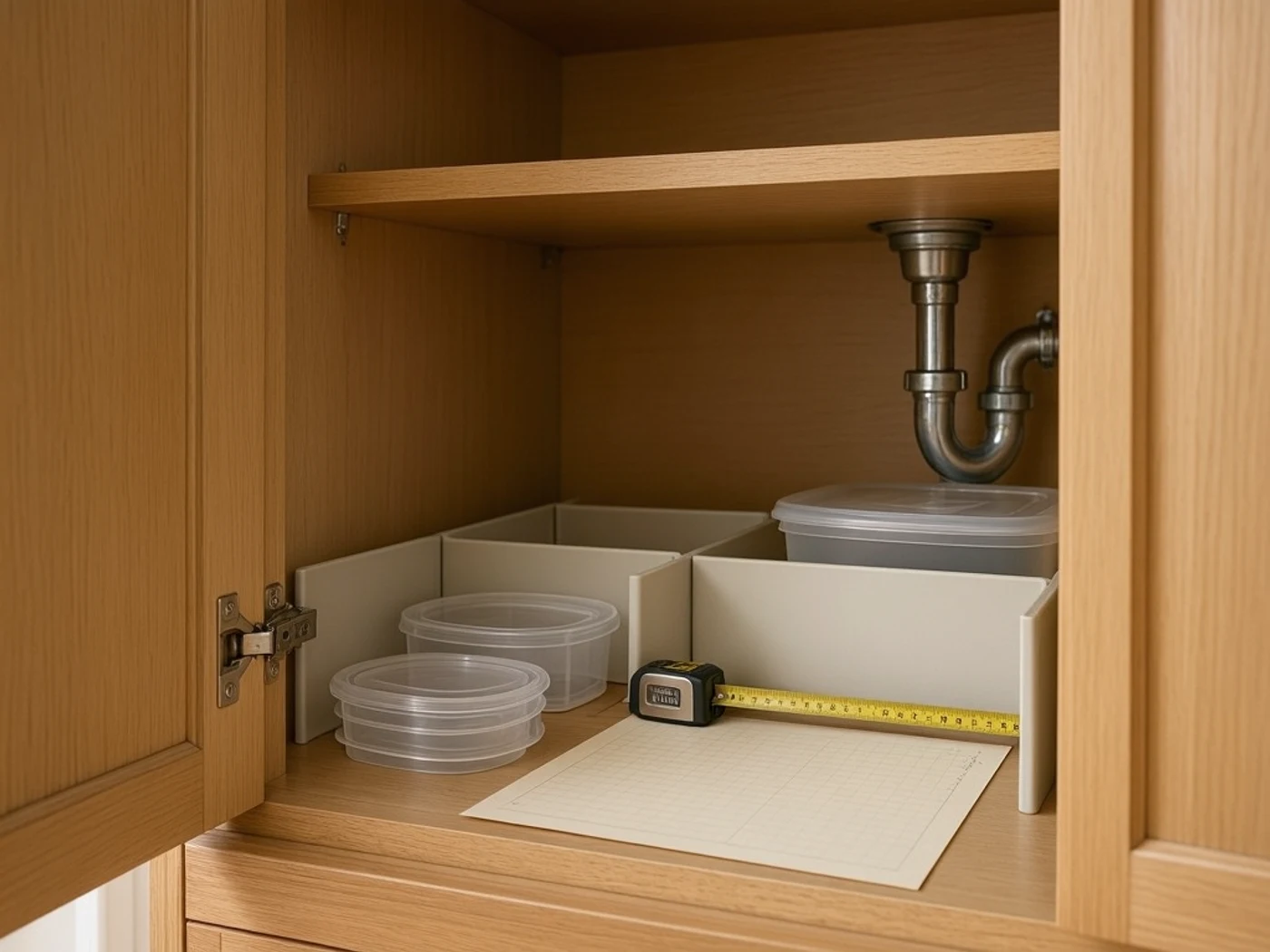
A consistent sequence prevents the mistake of comparing a product headline dimension with the cabinet’s outside dimension. Write measurements in this order: width, usable depth, clear height, opening, and obstructions. This sequence makes it easier to measure cabinet organizers consistently and compare several products without mixing numbers.
1. Record internal width
Measure left to right at several points and account for side walls, face-frame stiles, drawer slides, and hinge plates. If the width changes, use the narrowest section for a fixed organizer and note where the narrowing occurs. The smallest usable width is the safer number for cabinet organizer dimensions.
For a rotating product, measure the open area around the intended center point. A circular organizer may fit across the shelf but strike a wall or door when turned. For a rack or divider, check the body width together with handles, rails, and adjustable feet.
2. Record usable depth
Measure front to back with the door open, stopping at the first obstruction. Under-sink cabinets often have a drain line or supply pipe in the middle, so one uninterrupted depth number can be misleading. Draw a top-down sketch and mark the blocked zone.
Check whether the door swings into the storage area. A shallow organizer may fit behind the closed door while a deeper one catches the door panel or hinge. Measure cabinet organizers in the position where they will operate, rather than relying on the cabinet box depth.
3. Record clear height and entry height
Measure from the shelf or cabinet floor to the lowest point above it, then measure the door opening and diagonal installation clearance separately. A product can have suitable internal height but still be impossible to insert upright. For adjustable dividers, record the divider height as well as the base height.
Tall stored items may need to lean, and a top brace can interfere with removal. Leave room to grasp the organizer instead of filling every fraction of the cavity. Also record whether the organizer must be tilted, rotated, or partially assembled during installation.
Check obstructions and operating clearance
A fit involves more than three dimensions. Inspect hinge intrusion, shelf lips, door hardware, plumbing, electrical cords, and uneven surfaces. Take an empty-cabinet photograph, then mark measured limits on the photo or sketch so hidden obstacles remain visible during product comparison.
Hinges and door hardware
Open the door to its normal maximum and observe the hinge’s full movement. Some concealed hinges remain inside the cabinet envelope, while others project into the storage zone. Measure from the side wall to the farthest hinge point instead of measuring only to the hinge cup.
A door may close around a stationary bin but not around a pull-out tray. If a product rotates, verify that the hinge is outside its turning path. Do not rely on nominal cabinet width when the hinge is the narrowest point.
Shelf lips and uneven floors
A raised shelf edge can reduce the entry opening and stop a flat organizer from sliding backward. Measure the lip’s height and depth, then check whether feet or a base can clear it. An uneven floor can make a turntable wobble or cause a tray to sit at an angle.
For removable organizers, measure the route from the shelf to the doorway. Include the need to tilt, lift, or rotate the item. A solution that fits only after contents are removed may be practical, but that tradeoff should be intentional.
Pipes, cords, and safety access
Under a sink, map each pipe’s width, height, and distance from the walls. Add cords, filters, valves, and disposal equipment to the sketch. Do not press an organizer against a valve, connection, or cord simply to gain capacity.
Keep required controls and shutoffs reachable. The U.S. Access Board guidance on accessible routes is not a cabinet-organizer specification, but its emphasis on clear travel paths is a useful reminder when someone must reach or operate something.
Cabinet storage should not block a planned exit route or emergency equipment. For household planning, consult Ready.gov’s fire escape plan guidance and keep escape-related doors, windows, and paths usable.
Compare organizer and item dimensions
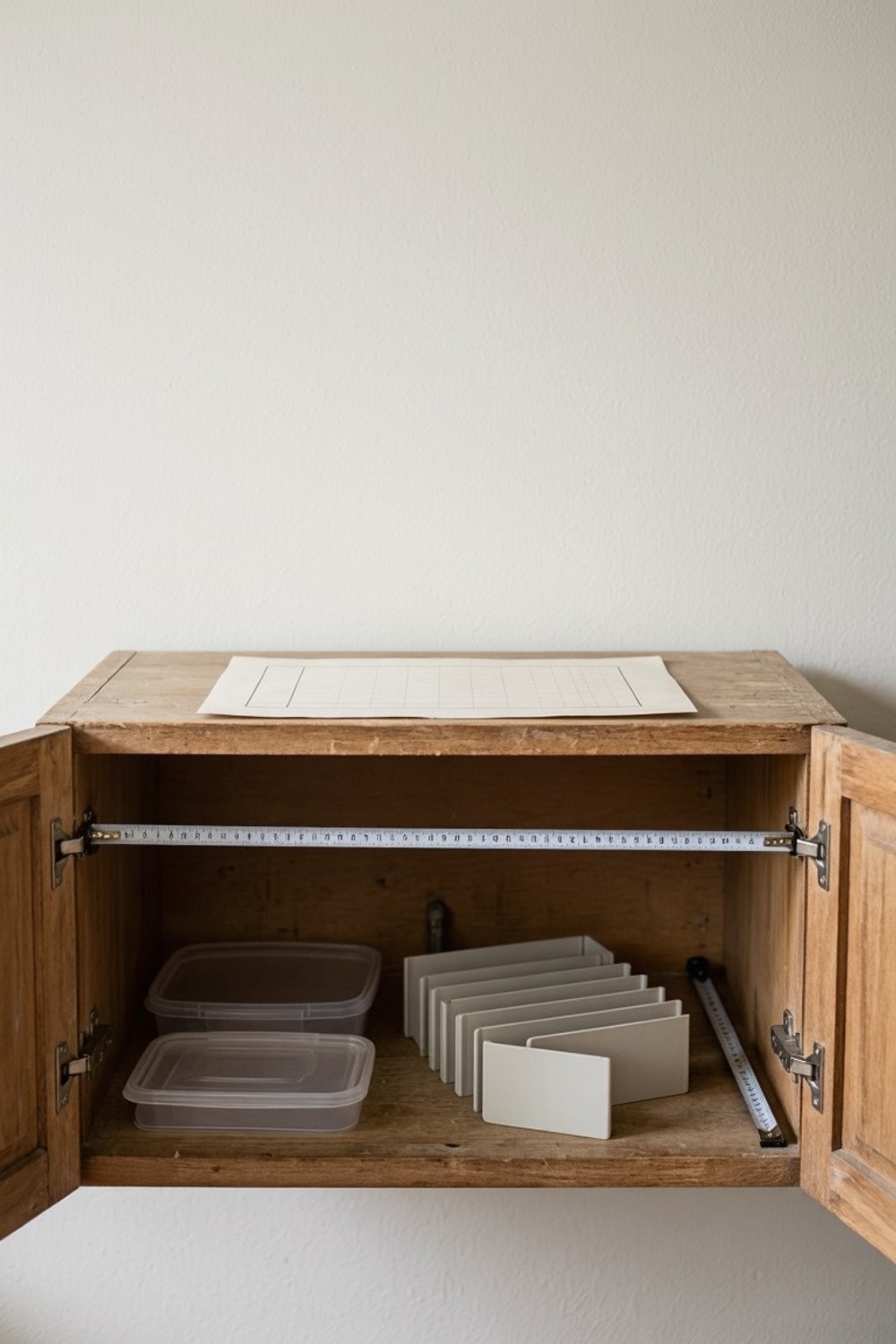
After measuring the cabinet, measure the objects that will go inside. Record the tallest, widest, and deepest item, plus the space needed to grip it. Lids, handles, pump bottles, and irregular shapes often need more room than their main container.
For dividers, measure the item footprint and the number of compartments required. For racks, check whether the item can be lifted over a rail. For a turntable, consider where your hand will stand while rotating it and whether stored items can be removed without moving neighboring items.
When you measure cabinet organizers, compare like with like: product body width to the narrowest cabinet width, product depth to usable depth, and product height to clear height. If a listing gives only an outside dimension, treat that as occupied space rather than interior storage capacity.
Think about access, not just capacity
A cabinet works when its contents can be found, grasped, and returned. Leave hand room above or beside frequently used items, because a tight arrangement may technically fit while forcing you to remove several objects before reaching the rear item.
For pull-outs, identify the full extension path. For a turntable, identify the complete rotation path. For a fixed bin, identify the lift-out path. A useful organizer fit checklist includes installation, daily use, and removal for cleaning or maintenance.
The small-space living category has additional space-planning ideas, while the storage-solutions category can help compare organizer types. These links are starting points, not substitutes for checking your own cabinet.
Review two example organizers
The following products illustrate why product dimensions are examples rather than universal fit rules. Marketplace prices, ratings, and review counts are dated snapshots, not quality proof, and they do not replace cabinet measurements.

Checked Jul 2026
YouCopia StoraLid Food Container Lid Organizer for Kitchen Cabinet Storage with 5 Adjustable Dividers, 10.5''D × 13.4''W × 3.3''H, Large Classic Edition, White
A current winning product selected through the Home Utility research and qualification workflow.
- Best for
- Readers whose measurements and use case match the verified listing information
- Know before buying
- The listed dimensions do not establish fit in a particular cabinet; hinge intrusion, shelf lips, door clearance, and lid sizes still require checking.
The YouCopia StoraLid example is a relatively low-profile organizer intended for container lids, with five adjustable dividers according to the supplied product title. Its 10.5-inch depth, 13.4-inch width, and 3.3-inch height should be compared with the smallest clear cabinet measurements, not an exterior cabinet label.
The manufacturer’s StoraLid product page provides product context. It cannot determine whether your cabinet door, hinges, or stored lids leave enough hand access.

Checked Jul 2026
Copco 18 Inch Lazy Susan Turntable Organizer - Nonslip Rotating Cabinet Organizer for Kitchen Pantry, Rimmed Edge, Wipe Clean
A current winning product selected through the Home Utility research and qualification workflow.
- Best for
- Readers whose measurements and use case match the verified listing information
- Know before buying
- A shelf that is 18 inches wide may still be unsuitable if a hinge, pipe, wall, door, or shelf lip interrupts rotation or removal.
The Copco example demonstrates a different measurement problem. An 18-inch turntable needs a clear circular area, and its rimmed edge can affect both the usable footprint and how items are lifted out. Under-sink plumbing is especially important because the available shape may be a cutout rather than a rectangle.
| Criteria | YouCopia StoraLid Container Lid Organizer | Copco 18 Inch Lazy Susan Turntable Organizer |
|---|---|---|
| Dimensions | 10.5''D × 13.4''W × 3.3''H | 18-inch stated diameter |
| Fit Check | Width, depth, height, divider and lid access | Circular rotation, hinge, pipe and hand clearance |
| Snapshot | 4.6 rating; 31,192 reviews; $17.80; verified 2026-07-13 | 4.7 rating; 13,334 reviews; $17.57; verified 2026-07-13 |
These dated Amazon marketplace snapshots indicate marketplace activity, not durability, safety, or suitability for a particular cabinet. Product cards use retrieved Amazon imagery when displayed by the site, while the editorial images in this article are generated illustrations.
Use the final fit checklist
Before buying, write the cabinet measurements beside the product measurements. Confirm the smallest internal width, usable depth, clear height, entry opening, hinge location, shelf lip, and all pipes or cords. Then confirm the organizer’s operating path and the dimensions of the objects it will hold.
Use this checklist before placing an order. Record each result beside the product dimensions so the final comparison uses the smallest usable clearance.
- Measure width at the front, middle, and back.
- Use the smallest clear width.
- Measure usable depth to the first obstruction.
- Measure clear height and the entry path separately.
- Photograph hinges, lips, pipes, cords, and uneven surfaces.
- Check door closing and full pull-out or rotation.
- Measure stored items and their hand-grip space.
- Confirm removal and cleaning access.
- Save the dimensions checked on the purchase date.
For related buying context, browse the reviews index and compare the Copco Lazy Susan review if it suits your project. Review the editorial policy before treating marketplace data as a recommendation, including its disclosure and methods information.
Limitations
This guide provides a measurement method, not an installation assessment or a guarantee of fit. Confirm current specifications with the manufacturer or seller before ordering.
No physical testing, independent measurement, certification review, or user survey was performed for this article. The supplied ratings, review counts, and prices were verified on the dates shown, but marketplace information can change. The two products are examples selected from supplied data, not universal recommendations.
Generated images are editorial illustrations, not official product photography. Use written dimensions and current product information for fit decisions.
Frequently Asked Questions
Should I measure the cabinet opening or the inside space?
Measure the usable inside space, then separately record the opening and hinge clearance. The opening determines whether the organizer can enter, while interior measurements determine whether it can sit and operate.
How much extra clearance should an organizer have?
Use the product maker’s requirements when provided; otherwise, leave practical room for movement and removal rather than aiming for a tight fit. Extra room is especially important for rotating and pull-out organizers.
Do cabinet hinges affect organizer fit?
Yes. Hinges can reduce usable width, interfere with rotation, or block a pull-out path. Measure their farthest projection with the door open and check the closing path before ordering.
What should I do if my measurements are irregular?
Record the smallest usable dimension, photograph obstacles, and choose an organizer with adjustable or clearly compatible dimensions. A sketch can show whether the cabinet is rectangular, tapered, or interrupted by plumbing.
Conclusion
The safest buying decision comes from comparing the cabinet’s smallest usable dimensions with the organizer’s full footprint and movement path. When you measure cabinet organizers, include hinges, lips, pipes, cords, hand access, and removal space rather than relying on a cabinet label or product name. The two examples show how to compare dimensions, but only your cabinet measurements can establish fit.