
This folding desk vs rolling desk comparison is mainly about where the desk goes when it is not being used. A folding frame can clear a room almost entirely, while a rolling frame keeps the workstation available but requires a parking spot. The better format depends on floor area, posture, equipment, and how often the room changes function.
The comparison covers storage footprint, deployment, mobility, stability, leg clearance, and task fit. It is intended for renters, studio dwellers, guest rooms, bedrooms, and other compact layouts where a conventional fixed desk may compete with circulation or storage.
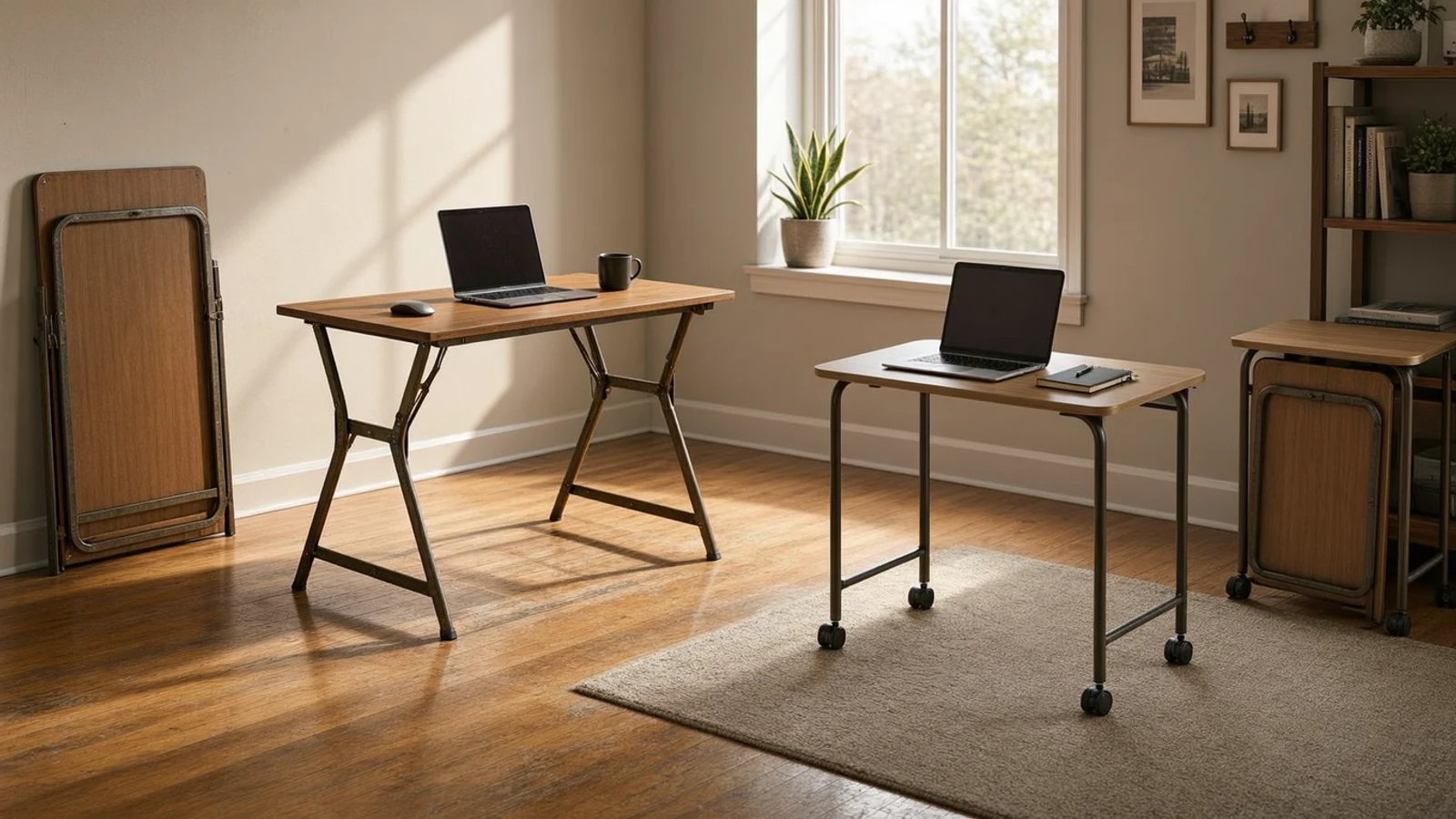
Table of Contents
- The central trade-off
- Storage footprint and deployment
- Mobility, stability, and clearance
- Task fit and product options
- How to measure before buying
- Limitations
- Frequently Asked Questions
- Conclusion
The central trade-off
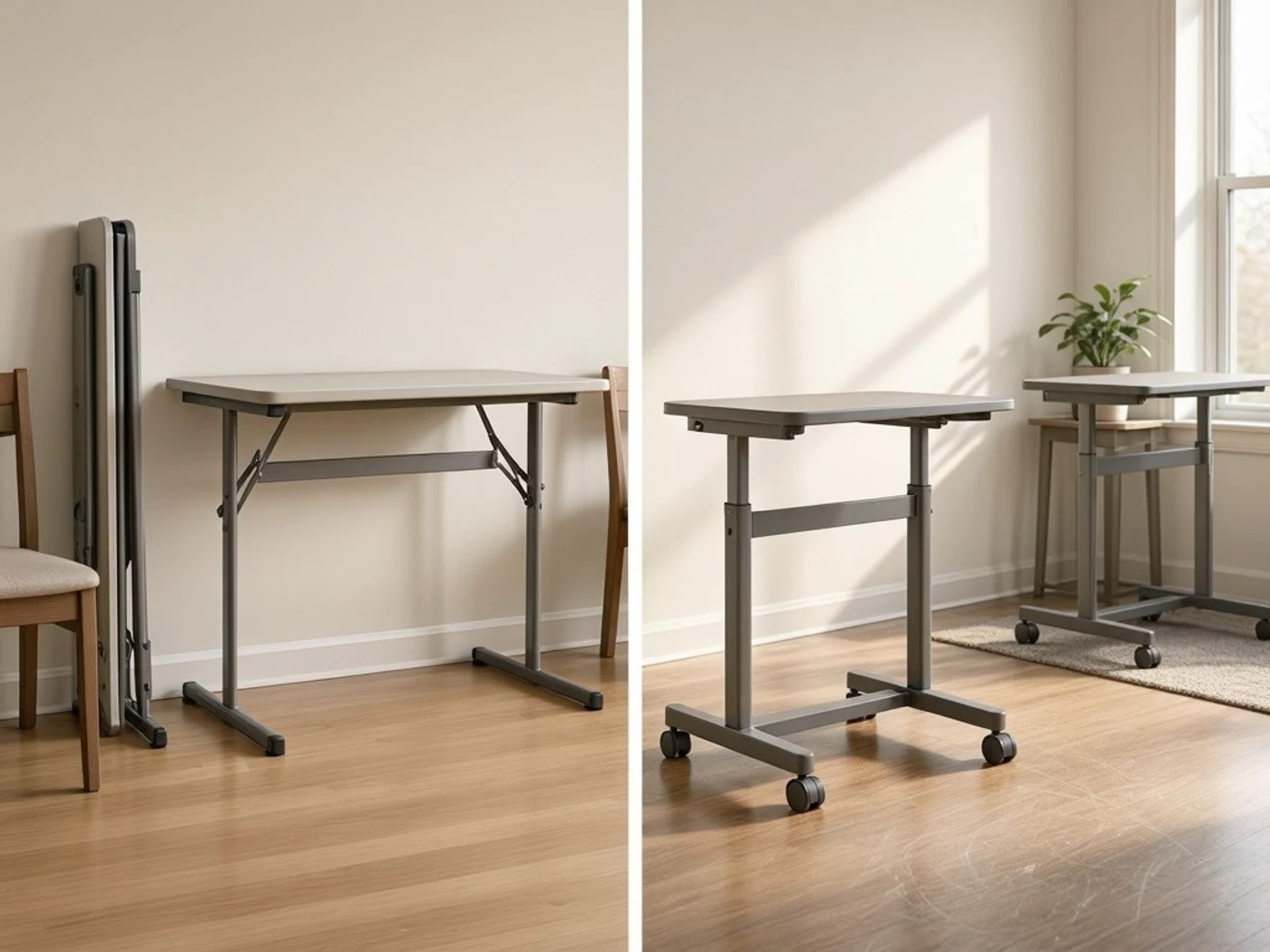
A folding desk prioritizes disappearance. When folded, it may be stored against a wall, behind a door, beside a wardrobe, or somewhere that does not need to accommodate a seated user. That advantage matters when the same room serves as a dining area, sleeping area, exercise space, or passage.
A rolling desk prioritizes availability and repositioning. It can remain set up for a laptop, monitor, notebook, or other light arrangement, then move closer to a window, sofa, bed, or outlet. The wheels do not eliminate floor-space needs; they change how that space can be used.
For a folding desk vs rolling desk decision, identify the inconvenience you experience most often. If the problem is a desk that occupies the room all day, folding storage is the stronger starting point. If the problem is an active workstation that must move between locations, rolling mobility may be more useful than a fully collapsible frame.
The choice is not automatically an ergonomic choice. A desk that stores neatly can still be too shallow, too low, or difficult to deploy. A mobile desk can have unsuitable surface height, limited knee room, or wheels that make typing feel less secure. Check fit before color, ratings, or a low listed price.
Storage footprint and deployment
When folding storage matters
Measure the desk in both positions, not only its advertised open dimensions. Folded width and thickness determine whether it can pass through a closet opening, fit beside furniture, or stand safely without blocking a route. Also note whether folding requires clearing the surface first.
Deployment has a practical cost. A folding desk may need a clear floor patch, two hands, and a place to put a laptop or accessories while it opens. If you expect several short work sessions each day, repeated setup and removal may become a burden even when the stored footprint is excellent.
The open footprint includes the chair, leg position, and space needed to approach the surface. A compact top does not necessarily create a compact workstation. Allow room to pull out the chair, shift your feet, and leave without scraping against a bed, wall, or cabinet.
When rolling storage matters
A rolling desk generally needs a permanent or semi-permanent parking position. That position should not narrow a hallway, block a doorway, interfere with drawers, or force the user to twist around nearby furniture. The desk can move, but it still needs a safe destination when not in use.
Check the path as carefully as the destination. Small casters may cross smooth flooring more readily than thick rugs, thresholds, cords, or uneven transitions, but the supplied product information does not establish performance on a particular floor. Treat every route as a measurement and observation task.
A portable desk for apartment living can help when one surface serves multiple people. Moving a desk with equipment adds handling demands and may require removing a monitor, drink, lamp, or other item first. A rolling design is most practical when its route is short, clear, and used regularly.
Mobility, stability, and clearance
Mobility is not the same as adjustability
A rolling desk can change location, while an adjustable rolling desk may also change working height. Those are separate functions. Height adjustment should be evaluated against elbow position, keyboard placement, screen position, and available knee clearance.
A folding desk may have fewer moving parts during use, which can simplify setup once it is open. That does not prove that every folding frame is stable, nor does it prove that every rolling frame is unstable. Inspect the base, hinges, fasteners, caster locks, and stated limits where available.
The Occupational Safety and Health Administration’s computer workstation guidance addresses comfort and arrangement around the user-workstation relationship. Its workstation components guidance adds context for screens, input devices, work surfaces, and seating. These sources support measurement-based evaluation, not a guarantee for either listed product.
Stability checks for a compact desk
Before using a folding desk, open every support fully and check that the frame sits evenly on the floor. Look for a positive locking or supporting action, confirm that the top does not shift excessively during ordinary typing, and keep heavy items centered unless instructions say otherwise.
For a rolling desk, engage the wheel locks before typing and reaching. Test whether the desk stays in place under ordinary hand pressure, and keep equipment within the manufacturer’s stated capacity. Do not infer a load rating from a product photograph or marketplace rating.
Leg clearance is separate from top size. Sit in the intended chair and measure whether knees, thighs, and feet can occupy the space without hitting a brace, drawer, crossbar, or lower shelf. A smaller top may work for a laptop but fail for a keyboard, mouse, notebook, and monitor arrangement.
Circulation matters in shared or accessible rooms. The U.S. Access Board’s accessible routes guide explains route concepts that can help you consider clear passage, turning, and obstructions. It is not a product-fit certification, and household layouts may have requirements beyond this article’s scope.
Task fit and product options
A foldable computer desk suits tasks that can be cleared at the end of a session. Laptop work, homework, occasional paperwork, and short-term guest use are plausible fits when the surface and chair position work for the user. Multiple monitors, permanent accessories, or frequent daily setup may favor a desk that stays assembled.
A rolling desk suits tasks that benefit from relocation. You might move it between a bedroom and living area, bring it near an outlet, or change its position for another user. Its usefulness depends on the travel path, wheel locks, working height, surface depth, and whether equipment can remain safely arranged.
The two supplied options illustrate the formats rather than settle the decision for every room. Their marketplace data was retrieved on July 12, 2026, and is a dated snapshot. Ratings, review counts, and prices are not quality proof, ergonomic proof, or a substitute for measurements.
| Criteria | Frylr folding desk | DUMOS rolling desk |
|---|---|---|
| Storage footprint | Folds for storage; confirm folded dimensions before purchase. | Needs a parking position; confirm parked depth and route. |
| Deployment | Requires opening the frame and clearing a work area. | Can remain assembled and move between clear locations. |
| Mobility | Manual carry after folding. | Caster-based movement; check flooring, thresholds, and locks. |
| Stability checks | Inspect supports, hinges, and level contact. | Lock casters and inspect frame movement under normal use. |
| Leg clearance | Measure the open underside with your chair. | Measure knee room across the height range. |
| Task fit | Laptop work and sessions that can be packed away. | Light workstation use where repositioning is valuable. |
Frylr Small Folding Computer Desk, 35.8 Inch

Checked Jul 2026
Frylr Small Folding Computer Desk, 35.8 Inch
A current winning product selected through the Home Utility research and qualification workflow.
- Best for
- Consider it when a 35.8-inch class work surface can open without blocking circulation and the desk must be stored after use.
- Know before buying
- Marketplace details and imagery can change; confirm the current Amazon listing before buying
The Frylr model is the folding-format option. Its supplied marketplace snapshot lists a price of $49.94, a 4.6 rating, and 1,359 reviews, verified on July 12, 2026. Those figures describe the listing snapshot only; they do not establish stability, durability, or fit in your home.
Its strongest conditional use case is a room that must recover floor area after work. Compare open dimensions with the chair footprint and folded dimensions with the intended storage location. If setup friction would make you avoid the desk, a rolling alternative may be more practical despite requiring a parking space.
DUMOS Mobile Adjustable-Height Rolling Desk

Checked Jul 2026
DUMOS Mobile Adjustable-Height Rolling Desk
A current winning product selected through the Home Utility research and qualification workflow.
- Best for
- Consider it when a mobile, height-adjustable work surface can stay parked safely and move along a measured route.
- Know before buying
- Marketplace details and imagery can change; confirm the current Amazon listing before buying
The DUMOS model is the rolling-format option. Its supplied marketplace snapshot lists a price of $45.98, a 4.6 rating, and 1,036 reviews, verified on July 12, 2026. These are dated marketplace signals rather than evidence that the desk suits a particular body, chair, floor, or workload.
Its conditional advantage is an assembled workstation that can change location. Check the lowest and highest working positions against your chair and elbow posture, then inspect whether the base or supports interfere with your knees. If the desk must cross rugs, thresholds, narrow turns, or crowded rooms, confirm that the route is usable without assuming caster performance.
How to measure before buying
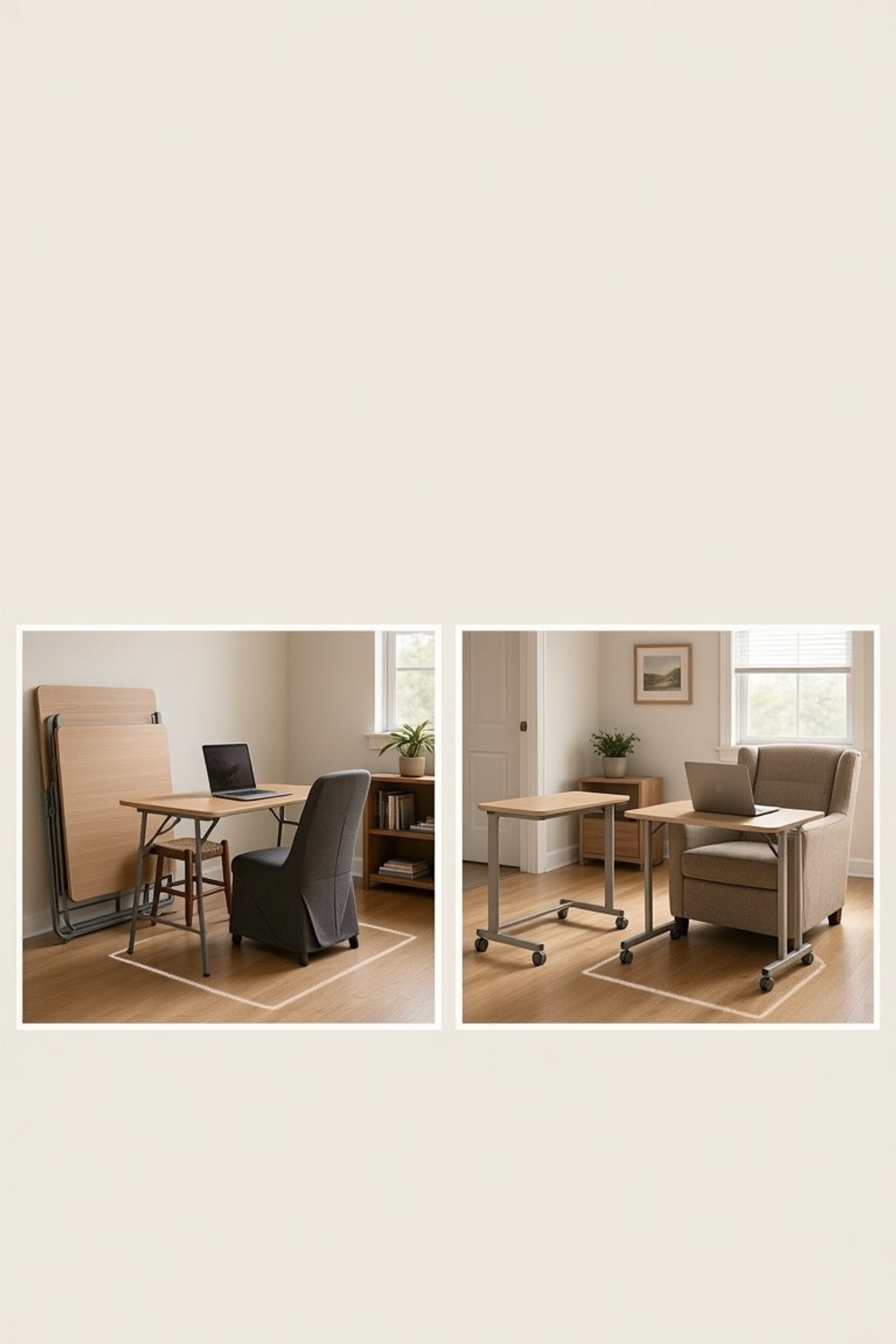
Start with the room, then the user, then the equipment. Record available width and depth at the proposed position, nearby obstacle heights, and the clear route to storage or another work area. For a folding model, record open and folded dimensions; for a rolling model, record active and parked dimensions.
Next, measure the chair and seated posture. Note seat height, armrest height, knee height, and the distance from the seat front to your feet. Compare those measurements with the desk’s underside, supports, and height range. A top that fits a wall may still fail to fit the person using it.
Then measure the equipment footprint. A laptop needs less depth than a monitor, keyboard, mouse, and notebook. Include cable bend space and outlet location, but do not assume cable management is included unless the listing states it. Keep cords out of walking routes and away from moving casters.
Use the workstation evaluation checklist to review posture, screen position, input devices, seating, and surrounding conditions. The checklist can improve the decision process, but it does not measure these products or certify either one.
For more compact-home ideas, compare this decision with the best small-space products guide and use the small-space product finder after recording measurements. The small-space living category and storage solutions category can help you consider the desk alongside the rest of the room.
Limitations
This article does not include hands-on testing, independent measurements, load testing, caster testing, or ergonomic assessment of either desk. The supplied product records provide names, marketplace imagery, prices, ratings, review counts, ASINs, and ranking fields, but not a complete dimensional specification or verified performance result.
Prices, ratings, and review counts can change after the July 12, 2026 snapshots. Marketplace ratings and review counts are not quality proof, and a higher count does not demonstrate that a desk fits your room, body, chair, equipment, flooring, or routine.
The three article images are AI-generated editorial illustrations, not official product photography. Product cards use retrieved Amazon imagery supplied in the project data. Verify current listing details, dimensions, instructions, return terms, and safety information before purchase.
For disclosure practices and source handling, see the editorial policy. You can also review other compact workspace formats in the reviews index and compare this decision with the Frylr folding desk review if that format is relevant to your room and task.
Frequently Asked Questions
Is a folding desk or rolling desk better for a very small room?
A folding desk is usually better when the work surface must disappear completely. A rolling desk is more useful when you need to move an active workstation without putting it away.
Can a rolling desk replace a permanent computer desk?
It can for a laptop or light workstation if its surface, height range, leg clearance, and wheel locks suit your equipment and posture. Confirm those details before treating it as a full-time desk.
What measurements matter before buying a compact desk?
Measure the open width, depth, and height, as well as the folded or parked footprint. Also measure chair clearance, route width, and the space needed to turn or reposition the desk.
Are marketplace ratings enough to choose between these desks?
No. Ratings and review counts are dated marketplace snapshots, not proof of fit, stability, durability, or ergonomic suitability.
Conclusion
A folding desk vs rolling desk decision should compare the whole occupied setup, not the furniture alone. Recheck the folding desk vs rolling desk choice with the chair, equipment, cables, and route in place before keeping it.
The better folding desk vs rolling desk choice is conditional: choose folding storage when reclaiming floor area matters most, and choose rolling mobility when an assembled workstation must move. Measure the open and stored footprint, chair and leg clearance, equipment, route, and working height before relying on product format, price, or marketplace signals.