
Home utility products for apartments should be screened by fit before appearance, features, or price. Start with the route, the operating footprint, access frequency, and the effort required to reset or store the item. This process helps separate a genuinely useful compact solution from a product that merely looks small in a listing.
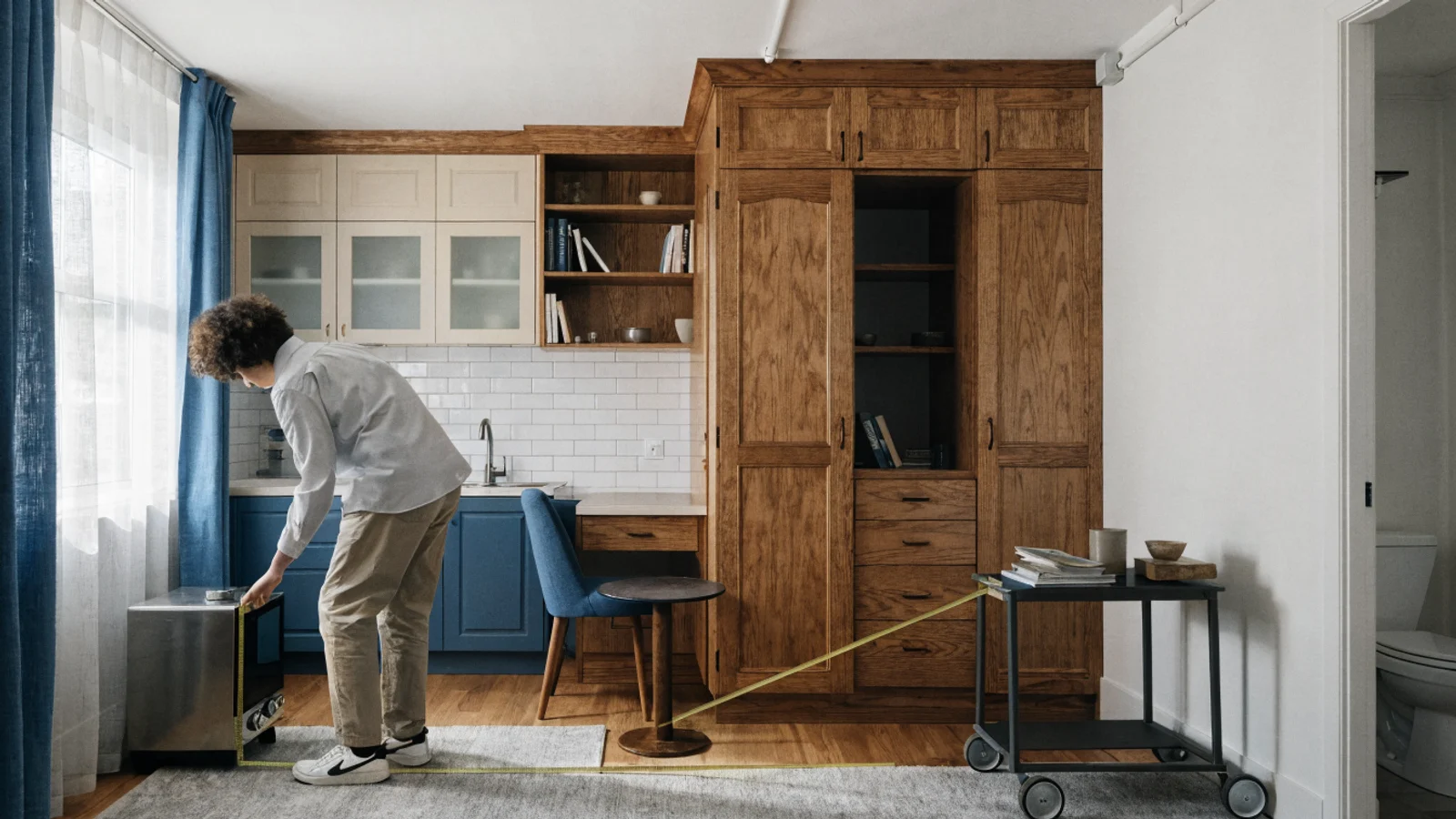
Table of Contents
- Start with the observed task
- Measure the complete fit
- Match storage to access frequency
- Compare product formats in two states
- Check stability, utilities, and care
- Use evidence before choosing a product family
- Build a renter-friendly decision
- Limitations
- Frequently Asked Questions
- Conclusion
Start with the observed task
Do not begin with a category such as “space-saving furniture.” Begin with an observed task: drying laundry, storing cleaning supplies, preparing food, charging devices, sorting waste, or reaching seasonal belongings. Write down who performs the task, where it happens, how often it occurs, and what currently makes it difficult.
Turn the task into constraints
Convert the observation into constraints before browsing products. A drying task may require airflow, a clear setup zone, and a place to park the rack; a cleaning task may require quick retrieval, a stable upright position, and access to a sink or outlet.
Next, describe the required capabilities without naming a product. For example, “supports several damp items while remaining movable” is a capability, while “buy a folding drying rack” is already a product-family decision.
Record uncertainty as well. You may not know the final load, the exact route through a furnished room, the available outlet capacity, or whether a landlord permits anchoring.
Measure the complete fit
Measure the destination, but do not stop there. Record the narrowest route point, door opening, door swing, turns, threshold changes, and any place where the product must be carried rather than rolled.
A useful planning distinction is the difference between clear space, approach space, and turning space. The U.S. Access Board’s guidance on clear floor or ground space and turning space can provide a vocabulary for thinking about those conditions, but its ADA facility requirements are not universal residential dimensions. Use the concepts as a planning lens, then verify the actual apartment.
Measure operating clearance
The operating footprint is often larger than the parked footprint. A cabinet may need clearance for a drawer, a hamper may need room for a lid, and a cart may require a turning path before it can be placed beside a counter.
Sketch the route and destination on paper or in a basic floor-plan app. Note fixed obstacles such as radiators, trim, plumbing, outlets, vents, and furniture that cannot move.
For a structured version of this process, use the measure-space-before-buying-furniture guide. It can sit alongside a simple measurement sheet with columns for route width, destination width, active depth, parked depth, and unresolved questions.
Match storage to access frequency
Storage should reflect how often an item is retrieved, not only how much empty volume it occupies. Daily-use items generally deserve low-friction access near the task, while weekly items can tolerate a cabinet, higher shelf, or less immediate location.
Rank the handling cost
For each item, count the actions required to retrieve and reset it. Opening a door, moving one lightweight object, unfolding a rack, or rolling a cart may be reasonable; removing several stacked containers, shifting heavy furniture, or clearing a route every time may not be.
Keep frequently used products visible when visibility supports use and the location does not obstruct circulation. Hiding everything can reduce visual noise while increasing abandonment if access becomes frustrating. The small-apartment-storage-plan guide provides a related way to assign zones by frequency and handling effort.
A storage location should also have a reset rule. Decide where the item returns after use, whether that location stays available, and whether another household task competes for the same space.

Compare product formats in two states
Compare folding, rolling, stacking, and fixed formats by examining both active and parked states. Folding can reduce storage depth but may add setup steps, hinge points, and a place to lean or secure the folded item.
Stacking uses vertical volume efficiently, yet the bottom item may become difficult to reach. Fixed formats can be simpler to use repeatedly, but they consume their footprint continuously and may require more deliberate placement.
Test the second function
Multifunction products should be evaluated as two or more separate claims. Ask whether each function performs a real task, whether switching modes is quick enough for the intended frequency, and whether the extra mechanism adds cleaning, storage, setup, or failure points.
A second function is not automatically valuable because it saves floor area. If one mode is rarely used or difficult to reset, the product may offer less practical utility than two simpler items placed in different zones.
Use the best-small-space-products guide for broader category comparisons, but retain the fit-first screen. A recommendation that works in one layout can fail in another because route geometry, utilities, household routines, and permitted installation methods differ.
Check stability, utilities, and care
Stability is a hard constraint for tall, narrow, loaded, or movable items. Consider the center of gravity, the weight distribution during use, the surface condition, and whether opening a door or drawer changes the balance.
The CPSC’s AnchorIt.gov guidance promotes anchoring furniture and televisions to reduce tip-over hazards. Renters should discuss permitted anchoring methods with the property owner before installation, and should not treat a no-drill preference as a reason to ignore a stability concern.
Verify utilities and maintenance
Check outlet location, cord reach, ventilation, water access, drainage, and heat exposure when the product needs utilities or produces heat, moisture, or debris. Avoid making a purchase decision from a product photograph that does not show the connection path or service access.
Care is part of fit. Identify surfaces that need wiping, parts that collect lint or residue, filters that require attention, and areas that become inaccessible when the product is parked.
Energy use can also matter for covered appliance categories. The Federal Trade Commission’s EnergyGuide explanation says the label can help compare estimated energy use and annual operating cost, but it applies to covered categories and provides estimates rather than a guarantee of an individual apartment’s bill.
Use evidence before choosing a product family
After defining the task and constraints, gather current manufacturer evidence for dimensions, operating instructions, weight limits, utilities, care, included parts, and installation requirements. Prefer a current product page or manual over an old summary, and record the date you checked it privately even though the purchase decision should remain useful if a listing changes.
Separate verified facts from assumptions. A listed width may not include a handle, a claimed capacity may depend on load distribution, and a “portable” description may not address thresholds or turning space.
Do not treat a category label as proof of suitability. First select the capability that meets the constraints, then compare product families such as folding, rolling, wall-mounted, stackable, or fixed.
The home product compatibility checker guide can help organize these questions across dimensions, utilities, and operating conditions. For a more focused shortlist, use the compact home product finder as the primary next step after completing the measurement sheet.

Build a renter-friendly decision
Renters should distinguish reversible placement from reversible installation. A freestanding item may still damage flooring, obstruct egress, overload a shelf, or become unstable when loaded.
Create a short decision record for each candidate. Include the observed task, required capabilities, measurements, route risks, active and parked footprints, access frequency, reset location, stability plan, utility needs, care burden, evidence checked, and unresolved uncertainty. This record makes it easier to reject attractive but incomplete options.
Use a reject-first rule for hard constraints. If the item cannot pass through the route, cannot operate without blocking a necessary path, lacks a safe stability plan, or requires unavailable utilities, remove it before comparing colors or optional features. If it passes, rank the remaining choices by low-friction use and credible evidence.
Limitations
This method cannot guarantee that a product will suit every apartment or household. Measurements can be incomplete, manufacturer specifications can change, and the actual experience can depend on flooring, furniture placement, load distribution, noise tolerance, and the habits of the people using the item.
The supplied access guidance is a planning reference, not a universal residential design rule. Energy labels apply only to covered appliance categories and use estimated comparisons. Safety decisions involving anchoring, electrical connections, heat, water, or structural changes may require property-owner approval or qualified advice.
When evidence is missing, the correct conclusion is uncertainty rather than a favorable assumption. Recheck dimensions and instructions before ordering, confirm return conditions, and avoid relying on a product photograph to answer a route, clearance, stability, or maintenance question.
Frequently Asked Questions
What should I measure before buying for an apartment?
Measure the destination, narrowest route point, turns, door swing, utilities, and the full space required to open, load, clean, or move the product. Include both the active footprint and the parked footprint, because a product can fit in storage yet fail during use.
Are multifunction products always better in small spaces?
No. A second function is useful only when it performs a real task well and does not add setup, storage, cleaning, or reliability costs that outweigh the saved footprint. Compare the full handling sequence for each function before choosing a combined format.
How should renters approach furniture anchoring?
Treat stability as a hard constraint, consult current safety guidance, and confirm permitted anchoring methods with the property owner before installation. If anchoring is needed but the permitted method is unclear, pause the purchase rather than assuming a workaround is adequate.
Should daily items be hidden to reduce visual clutter?
Not automatically. Daily items generally need low-friction access, while hidden or high storage is better suited to lower-frequency belongings. Choose a location that supports the actual routine and preserves a clear route.
Evaluate home utility products for apartments against the active routine as well as the parked footprint. A format that fits only when unused has not yet passed the practical fit test.
Use the home utility products for apartments plan as a decision record, not as permission to buy every compact-looking option. Missing evidence remains a reason to pause.
Recheck home utility products for apartments when furniture placement, household routines, or lease conditions change. A previous fit decision may no longer describe the route, access pattern, or permitted installation.
Conclusion
A fit-first purchase starts with a task and ends with verified constraints, not with a generic list of compact features. Measure the route and operating state, rank access and reset effort, compare formats, check stability and utilities, and record uncertainty before selecting a product family. This method makes home utility products for apartments easier to evaluate without assuming that the smallest parked footprint is the most practical choice.